
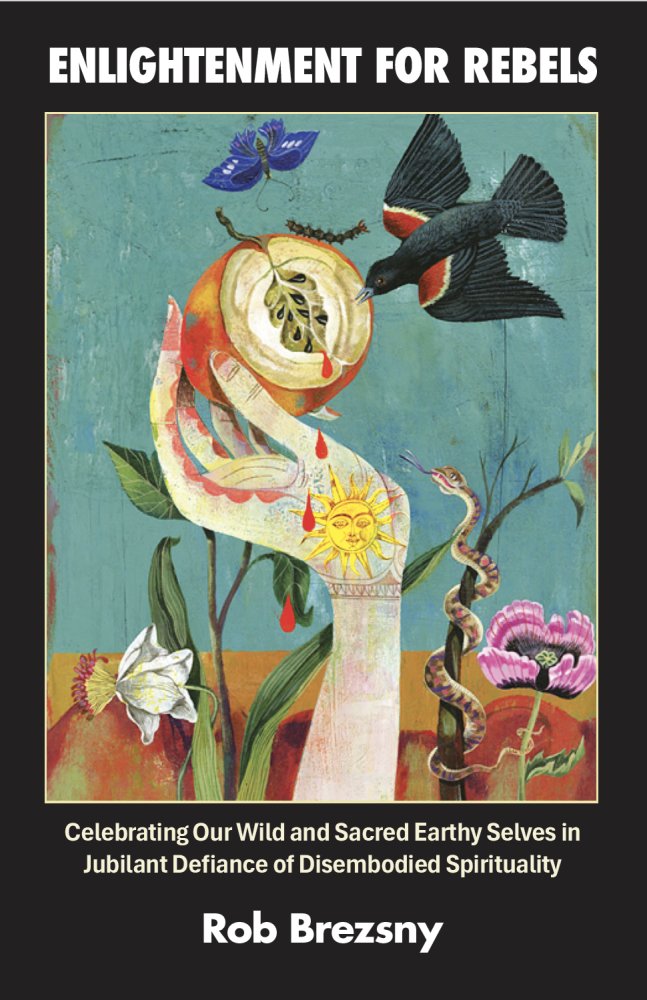
Enlightenment for Rebels
Celebrating Our Wild and Sacred Earthly Selves in Jubilant Defiance of Disembodied Spirituality
In this reverently rowdy text, Rob Brezsny proposes versions of enlightenment that don’t require an escape from our world’s gorgeous pandemonium, but thrive on a wildly disciplined engagement with it.
25.99 print edition
Much of modern spirituality preaches escape and denial. We seekers are politely nagged to transcend our bodies, silence our desires, shed our stories, demonize our egos, downplay our feelings, and even dissolve our precious selves — as if holiness begins where humanness ends.
Enlightenment for Rebels is a raucous, lyrical uprising against that seductive illusion.
In these stories, essays, poems, and other joyously unclassifiable forms, Rob Brezsny celebrates the messy miracle of incarnation. He argues that our wounds, yearnings, and confusions aren’t obstacles to enlightenment, but the very curriculum.
BECOMING FINDABLE
What does it mean for us to “become findable”? How do we do it?
The playful art of becoming findable is not about chasing the goodies we want but creating conditions that enable the goodies to find us.
Imagine making ourselves visible and attractive to opportunities.
Imagine positioning ourselves in the path of luck and destiny.
Imagine sending irresistible signal flares into the great unknown.
Imagine: We can’t control what comes, but we can influence who sees us, recognizes us, and knows where to look for us.
Imagine preparation, not pursuit. We don’t hunt but ripen.
Here’s a news flash about all the hustle-culture clichés like “manifesting our dreams.” Many of them are based on the exhausting premise that we must obsessively chase down the treasures that will fulfill us.
With steely gleams in our eyes and gritty heroism in our hearts, we supposedly have to force reality to bend to our will through rugged determination and positive thinking.
The spiritual industrial complex perpetrates the same dirty trick with awakening. It sells us the idea that enlightenment is a prize we achieve through the accumulation of meditation hours, retreats, purifications, reading holy texts, and maybe some mortifications thrown in there, too.
If we just push hard enough, we will break through to the other side. Our <i>Enlightenment for Rebels</i> shuns the gospel of hustle and the spiritual industrial complex. We ignore the bootstrapping propaganda that says grind harder. For us, becoming findable is a subversive triumph. Our method is stranger and more elegant: ripen ourselves.
+
Think about how a flower attracts pollinators. It doesn’t chase bees. A lilac bush never zips around the garden trying to coax insects to visit.
Its brilliant strategy is to become so vibrantly itself—so fragrant, colorful, and rich with nectar—that pollinators can’t help but find it.
The lilac’s work isn’t to engage in pursuit but to develop its full lilac-ness. The playful experiment of flirting with enlightenment has similarities.
Awakening isn’t a possession we hunt down and capture. It arrives when we make ourselves findable to the rhythms and rhymes of grace.
This inverts the stodgy spiritual narrative. Instead of asking, “How do I corral a big shiny batch of enlightenment?”, the question morphs into “How do I cultivate the kind of soul that enlightenment recognizes? How can I position myself in the path of awakening?”
Here’s a five-step guide:
First, we get clear about our signals. What messages are we broadcasting into the world? Not what we hope we’re broadcasting, but what we’re actually emanating through our choices, attention, and energy.
Maybe we say we want awakening but we’re still performing the small self ’s drama: stalking status, accumulating grievances, defending our righteousness, and clinging to our wounds as identity.
In that case, we’re almost certainly unfindable. We are camouflaged as our false self. Enlightenment can’t detect us because we’re dressed up as the type of character that enlightenment avoids.
But let’s say we soften our defenses and question our certainties. We get curious about obstacles we might be generating. Then we begin emitting a different frequency that could make us more visible to the robust versions of enlightenment.
We Rebel Enlightenment aspirants call this “spiritual ripening.” We can’t make the fruit be ready faster by yanking on it, but we can focus on ensuring it has sufficient sun and water.
+
A second cagey strategy we can invoke to become findable is to situate ourselves in the path of awakening.
Do we want to rouse ourselves from our habit minds and studied ignorance so we can dwell periodically amidst luminous curiosity?
Then we will study people who have done it, not as celebrities we adulate but as field guides to the mysterious territory. We practice one of the myriad varieties of meditation, not compulsively but consistently.
We put ourselves in situations that crack open our chronic cycle of anxieties, like nature, art, sex, service, deep conversation, dancing, and singing. Getting educated is helpful. We can be wise and inquisitive fools who inhabit enlightenment-rich environments. We locate ourselves in ecosystems where awakening circulates.
Musicians don’t get discovered by sitting alone in their apartment. They play open mics, jam sessions, and every gig they can get. They collaborate with other musicians and speak highly of those whose artistry and soulfulness they enjoy. Do they know friends who know friends who are talent scouts? They lubricate such connections.
Similarly, awakening doesn’t usually find us while we’re scrolling Instagram and complaining about our ex. It grazes us when we’re positioned where lucidity and illumination like to hang out.
+
Here’s a third tender trick for becoming findable: Prepare ourselves to recognize awakening when it cruises into our vicinity.
The obvious secret is that enlightenment may come disguised. It shows up on an ordinary Tuesday while we’re washing dishes. It edges its way into our intuition during pauses between thoughts and transitions between appointments. Maybe it swoops down on us when we momentarily forget to cling to our tormented story about who we are.
Let’s hope we’re not rigid in our expectations about what enlightenment looks like, fixatedly anticipating floods of white light and cosmic consciousness and throbs of bliss. If we are, we may miss it when it shows up as simple, clear, ordinary grace.
Here’s a fourth tiny little gigantic action we can undertake to become findable: Remove obstacles that make us unfindable to awakening, enlightenment, or illumination—or, as we like to name it, Blazewake!, Truthflash!, or Soulburst!
Is there anything blocking our signals? Maybe it’s spiritual ambition. We’re so driven to achieve enlightenment that we can’t see we’re already in its midst.
Maybe it’s perfectionism. We’re waiting and hoping to someday be pure enough and good enough.
Maybe it’s bitterness. We’re so armored against disappointment that numinous revelations can’t reach us.
Becoming findable for enlightenment might require subtracting more than adding. It may mean banishing the static of spiritual ambition and saying no to the practices that are just ego reflexes in disguise. Then maybe we can say yes to the elegant presence that has been there all along.
+
Here’s another not-so-top-secret technique we can harness to become findable: Trust the timing that isn’t ours to control.
The seed germinates when conditions are right: enough water, oxygen, and light, plus the right temperature range.
Likewise, the blessed breakthrough of higher, deeper awareness erupts when it’s ready. We can’t force it to arrive faster by wanting it harder or meditating longer.
The timeline may be slightly under our control, but mostly not. Our main job is to keep doing the patient work of preparation. Continue practicing and questioning and cultivating receptivity, even when nothing seems to be happening.
Here’s a sweet-and-sour corollary: Becoming findable to awakening is a practice that usually works on a scale that’s only slightly visible. We’re creating conditions whose effects might not mature for years.
This is at odds with the spiritual hustle narrative, which says we have to grind ourselves into transcendence NOW through the pure force of will. Let’s sing the chorus one more time, louder and with a twist: Enlightenment is already looking for us. It has been searching and scanning for us forever. The universe wants to wake up to itself through us. We mean this literally. It’s not metaphor or poetry.
But enlightenment can only locate us if we’re not camouflaged. We’ve got to show up as we are—confused, earnest, excited, broken, willing, eager. That’s how we become fully visible. We emit a fragrant beam of YES that awakening recognizes: “Here is a soul who’s ready—positioned in my swath and prepared to receive me when I arrive.”
+
Now here comes the bridge of our tuneful anthem, the penultimate echo of the lyrical theme: The practice of becoming findable is an act of rebellion—not with raised fists and shouted rants, but with a subtle, nuanced devotion that undermines the whole game.
The mainstream spiritual market and the secular hustle culture are, beneath their surface differences, running the same operating system: You are not yet enough, and achievement will fix that.
Becoming findable refuses to feed that system. It says our souls are already legible to grace; the task is to stop concealing our gorgeous essence under greed and ambition.
In the framework of <i>Enlightenment for Rebels</i>, this isn’t a retreat from the world but a deeper engagement. It trusts reality’s own momentum rather than trying to override it with willpower.
We rebels aren’t storming the gates and jamming the traps that are supposedly guarding the lucid wild treasure of blissful realization. We are making it easy for the lucid wild treasure to find us.
+
PS: The practice of becoming findable for enlightenment isn’t separate from enlightenment itself. The preparation, positioning, and ripening comprise the awakening.
The seeking and the finding aren’t separate. We’re becoming findable because that’s what awakening looks like while it’s in progress.



HARBINGER: JOY AND GRIEF
In 2005, I published the first edition of Pronoia Is the Antidote for Paranoia: How the Whole World Is Conspiring to Shower You with Blessings.
Four years later came the expanded 400-page version, with 55% additional new material. Translated editions bloomed across the world: Spanish, Italian, Greek, and Turkish. I became the godfather prophet of pronoia.
The term itself was born in the 1970s from the mind of author John Perry Barlow, who envisioned it as paranoia’s radiant twin—“the suspicion that the universe is a conspiracy on your behalf.”
But Barlow didn’t develop the notion beyond his brief definitions. That project became my calling, and I pursued it with the fervor of an archaeologist uncovering a lost civilization. I resolved to be relentless in naming and celebrating all that is beautiful and interesting and healing in our bewildering world.
My philosophy rests on three radical propositions: that the universe is a prodigious miracle created for our amusement and illumination; that all of creation conspires to liberate us from suffering while motivating us and educating us to love with precision, intelligence, and courage; and that life delivers exactly what we need—not what we want, but what our souls require—to fulfill our deepest purposes. (PS: These worthy goals may take more than one incarnation to accomplish!)
Core tenets:
· Evil is boring, sterile, and stupid.
· Cynicism is intellectual laziness masquerading as sophistication.
· Fear is a bad habit we can at least partially unlearn.
· Despair is an impotent luxury with no redemptive power.
· Joy is fascinating, revelatory, and necessary.
· Love is an act of heroic genius, requiring bold perseverance and cultivated skill.
· Pleasure is not an indulgence but a birthright.
· Receptivity is a superpower.
But now the plot thickens: I am not a saccharine optimist who ignores life’s brutal realities. At the core of my perspective on pronoia lies an intimate, unflinching relationship with darkness. I don’t ignore or transcend shadows; I engage and negotiate with them.
Here’s a key element of my formulation: Yes, life orchestrates a vast conspiracy to keep us supplied with blessings, but what constitutes blessings? Ten million dollars? A gorgeous body? A hassle-free marriage with a perfect soulmate? A mansion filled with lavish accessories?
Maybe. But more often, the blessings arrive as plot twists we didn’t anticipate. They may bring dizzying adventures that remake us, gifts so unexpected we hardly know what to do with them, challenges that invite us to become smarter and wilder and kinder, and conundrums that dare us to grow luminous and numinous.
LIsten free to the song about that: https://televisionary.bandcamp.com/track/shadow-blessings
Among the conundrums that have dared me to grow more luminous and numinous is a tragicomic irony about my own soul’s assignment.
The realization slammed into me years ago. I was driving on Highway 1 north of Point Reyes, California after a rare argument with my beloved partner, determined to cool my troubled heart by staring at the white sky and grey ocean until they scoured me clean. A storm seemed imminent. The waves were bruised and restless.
Needing a break and wanting to write down a torrent of tormented thoughts in my notebook, I pulled over into a gravel turnout and parked. When I got out of the car, I had to concentrate on anchoring myself in the face of the steady gusts. Soon I noticed a shrine wedged down near the ground between two boulders. It was modest, but every object within it radiated stubborn endurance.
Wilted, mud-heavy lilies formed a roughly circular boundary around the ceremonial space. There were three candles in glass jars and three dead starfish. A child’s rubber boot, pink once, was now sun-blanched to a weary rose. A weather-beaten teddy bear with one eye missing, its remaining eye cloudy and scratched, gazed outward with a look of baffled tenderness.
There were messages, too: handwritten notes on thick index cards stuffed into rock crevices. Some were barely legible, half-erased by the elements:
We miss you.
Come visit us in dreams. Forgive us.
You changed us.
A few stones had been painted with spirals, hearts, and a stick-figure family holding hands beneath a wan sun. A single abalone seashell was positioned at the center like a small altar bowl, mottled with rainbow flashes whenever the clouds parted.
The whole shrine had the look of having been tended by many hands at various times, but also neglected for long stretches, as if grief came in unpredictable waves.
It was woebegone, unglamorous, and defiant in its shabbiness. I imagined it to be a shrine for a sorrow too enormous or complicated to fit into the easy categories of public mourning.
I stood before it too long. The wind moaned in strange harmonics around the rocks, like an animal circling me. The sky became a color I had never seen before, a blend of purple, silver, black and blue. A seagull’s cry cut through the wind and raised the hairs on the back of my neck. Instead of the usual squawk, I swear it shrieked my name three times: “Rob! Rob! Rob!”
Then a rupture rose up in me from solar plexus to throat: I felt an alien emotion that wasn’t mine blooming in my chest. It was a denser, older, more electric version of empathy.
The grief didn’t feel like it belonged to me, exactly, nor even to one family or one tragedy. It felt like a delta of losses converging from the whole wide world: every drowned wish, every vanished child, every unspoken apology, every hurt creature wailing in the great chain of being. I imagined it as a collective sorrow that had been temporarily stored in this heap of objects and that finally found me available and unguarded enough to hold it.
My knees buckled. I felt simultaneously enormous and hollow, as if I’d become a vessel whose only purpose was to contain this tsunami of loss. The sensation was both exquisitely precise and overwhelmingly diffuse. It was like being pierced by a thousand fine needles made of age-old sadness, each one carrying a story of irretrievable absence.
There was also a sweetness in the anguish, an alien honey-thick tenderness woven through the pain. I wasn’t drowning in it; I was being initiated by it. My chest expanded to accommodate a surge of anonymous agony I couldn’t name: the mother who never got to say goodbye, the lover who died mid-sentence, the child who vanished into an ocean, or the merciless machinery of human cruelty.
I wasn’t being punished or overwhelmed; I was being trusted. And that trust wrestled itself down into my bones like a hot coiling drill. I swore I felt it in my spine and pelvis and both femurs. It was as if I’d been chosen to receive this blessed curse because of my capacity to hold tremendous quantities of affliction that didn’t belong to me.
The sorrow carried intelligence. It had weight, temperature, and texture. It asked not for fixing or fleeing, but for presence without flinching. I felt like the grief was reorganizing me, enlarging my power to love without conditions or caveats.
As the rupture vibrated in my belly and chest, it unleashed a further breach. Mixed with the sorrow was a sense of an unmistakable assignment.
The grief didn’t merely want release. It wanted interpretation, reanimation, and alchemy. It bid me to carry it forward without corrupting it, so it would be neither sentimentalized nor weaponized. I swear I heard it speak to me: I chose you because you won’t collapse or perform martyrdom or pretend it’s not happening.
I whispered aloud, “Why me?”
The ocean answered with a rogue wave that slapped the cliffs with such force I lurched backward. In that sonic boom of saltwater and stone, I heard the unmistakable response:
Because you already praise holy beauty. Now learn to praise holy hurts.
As vividly as if it were now, I remember standing at that woebegone shrine while the vast grey Pacific Ocean shoved a massive, unwieldy truth into my bloodstream. That was the moment I fully coalesced into the living container who praises the miraculous with fervor while metabolizing the unbearable.
I fully grasped my twin assignments: to celebrate the world audaciously and carry its grief tenderly.
Ever since, I understand that my drive to gather the world’s grief springs from love: profound, unreasonable adoration for our broken, magnificent world. To earn the right to ameliorate suffering, I must first feel it as deeply as it goes. To speak authentically about bliss and pleasure, I must be intimately familiar with sorrow.
Ever since, each praise-song I write has had to carry salty tears. Every gift I offer the world is seasoned by my willingness to sit with what can’t be fixed but only felt and witnessed.
This is the harbinger’s burden and privilege: to be a bridge between what breaks us and what makes us whole. It means I’m not numbed by contradiction but buoyed by completion.
I extol the world’s beauty with ferocity precisely because I know how fragile it is. I celebrate wonder with such abandon because I can hold horror without flinching.
My initiation at the windswept shrine became foundational to everything I now understand about Rebel Enlightenment.
The disembodied spiritual traditions I reject promise transcendence from suffering. Avoid suffering at all costs, they say. They exalt an escape velocity that launches us beyond the messy, mortal realm into a sterile, pristine elsewhere.
But the liberating illuminations that have remade me again and again arrive through my willingness to be a full-bodied vessel for both ecstasy and anguish.
When I expanded to hold that collective grief without numbing or fleeing, I didn’t fly away into heavenly consolation. I dived more deeply into my life’s mission. And that descent made me exquisitely available.
Every Ecstatic Healing Derangement and Friendly Shock Awakening I’ve experienced since then has confirmed this: The sacred doesn’t seek the sanitized or the safely detached.
It hunts for those of us who are brave and brazen enough to be vulnerable, rumpled, and shockingly alive. Can we hold grief in one hand and rapture in the other without needing to choose between them?
This is the paradox at the heart of Sacramental Incandescent Embodiment: Only by refusing to abandon our earthly selves can we become spacious enough for the healing elixir of inscrutable divinity to move through us without destroying us.